
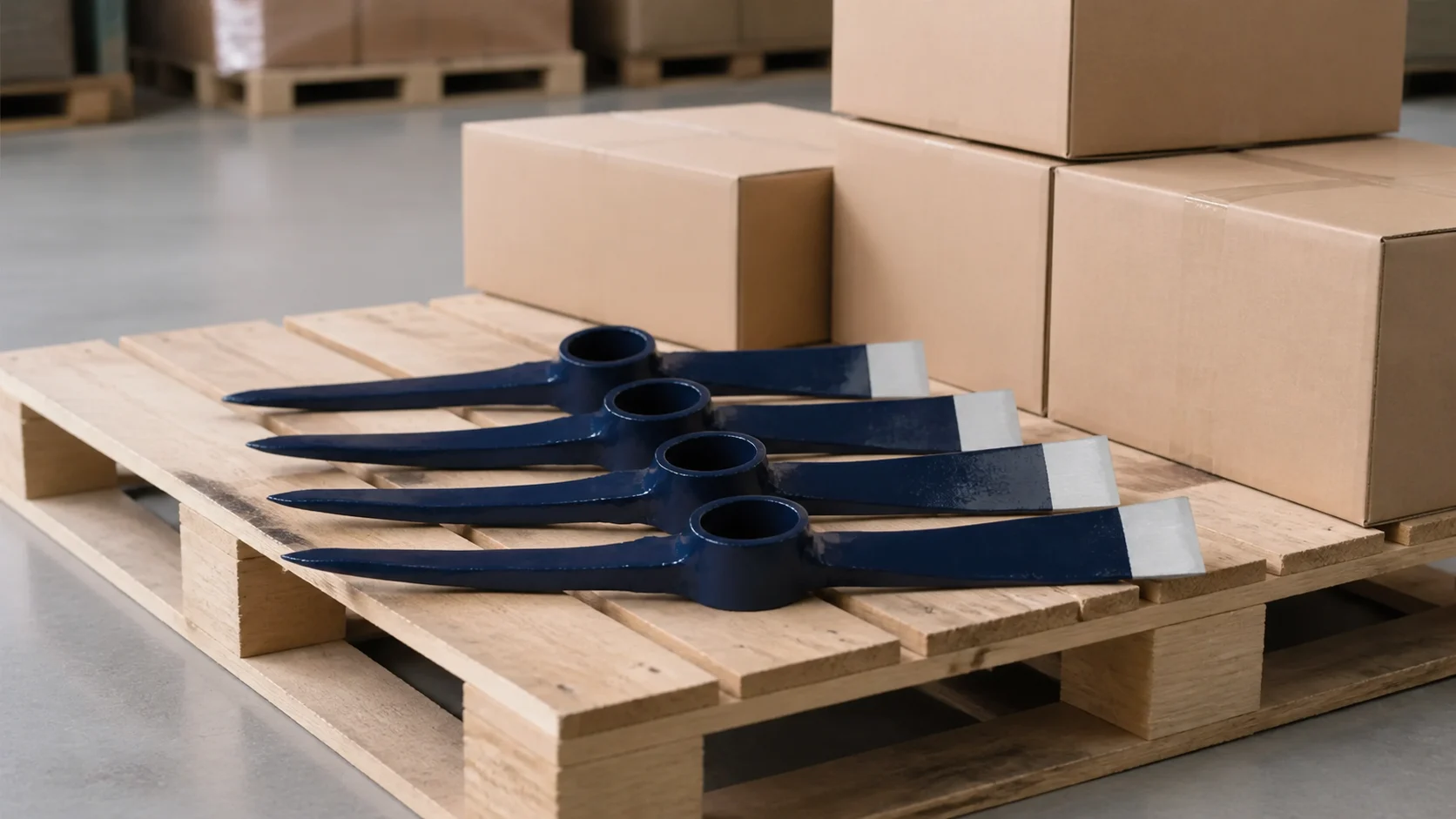
Steel Pickaxe P402 is a forged steel, head-only product line for construction tool channels and farm supply assortments. The product reference shows a central oval handle eye, a long pointed end, and a broad chisel-style end. That pattern is not a finished handled pickaxe: the head, selected handle fit, finish, packing, and destination-market requirements should be confirmed as separate parts of the purchase plan.
The Steel Pickaxe P402 product page records six catalog weight options: 0.4 kg, 1 kg, 2.2 kg, 5 lb, 6 lb, and 7 lb. It also records head-size references from 285 x 55 mm to 590 x 43 mm, depending on the selected weight. These are useful quotation references, not a reason to combine several versions into one unnamed item. A buyer should state the chosen weight, the corresponding model reference, intended handle arrangement, finish instruction, quantity, packing requirement, and target market on each order line.
Why a P402 head needs its own specification
Head-only tools can simplify an import program when buyers plan local handle assembly, replacement-head sales, or compact loading with other hardware. They also create a specific responsibility: the eye must suit the buyer's intended handle system. The P402 record identifies an oval eye, with up/down hole dimensions dependent on the selected weight. Before approving a bulk order, confirm the eye shape and the applicable dimensions against the actual handle plan or an approved reference sample.
Do not assume that another pickaxe model uses the same eye, head length, point profile, or broad-end profile. Even products that look related in a category photo may be assembled with different handles or sold into different market programs. Keep the selected P402 version identifiable through its model name, product image, chosen weight, head-size reference, eye requirement, and packing note. This lets the buyer, supplier, inspector, and receiving warehouse review the same item rather than a generic “pickaxe head.”
Choose the catalog weight and head size together
The product data pairs weight selection with different head-size references. Buyers should therefore choose the target option first, then verify the associated length and width reference rather than ordering only by a broad product name. If the destination market uses pound-based buying language, write the requested pound option. If the buying list is metric, write the chosen kilogram option. Where both are used in the same program, preserve the unit exactly as agreed so that the quotation, sample, carton mark, and later repeat order remain aligned.
The catalog gives the P402 family as 0.4 kg, 1 kg, 2.2 kg, 5 lb, 6 lb, and 7 lb options, with size references including 285 x 55 mm, 385 x 60 mm, 516 x 36 mm, 520 x 53 mm, 547 x 40 mm, and 590 x 43 mm. Confirm the specific pairing in the quotation and sample record. Exact tolerance, finished weight, dimensional requirement, and any local compliance requirement should be agreed for the selected SKU; they should not be inferred from a catalog image or from a different P402 option.
Check the eye and the two working ends at sampling
A practical sample review begins with the full head from both sides, then focuses on the central oval eye, pointed end, and broad chisel-style end. The buyer can compare the selected head form with the handle system, product photo, and agreed model reference. For head-only supply, the handle is not an afterthought: if the intended assembly uses a particular handle shape or fitting process, that compatibility should be checked before the first bulk order.
The visible reference uses a dark painted body with a bright bare-metal area at the broad end. Treat that appearance as a visual reference only. State the required paint color, surface condition, edge presentation, and any buyer-specific finish expectation in the sample notes. This is more reliable than asking for “the same finish” after production has begun. A clean approval file can include the sample photos, chosen weight, eye reference, end-shape views, packing instruction, and any signed-off comparison points.
Keep P402 separate from related pickaxe patterns
The Pickaxes category contains several pickaxe and mattock options for different buyer programs. It is useful for comparing product families, but it should not become one shared specification. The product name, head pattern, eye, weight, dimensions, finish, packing, and intended assembly can vary by SKU. Use a separate line for every model that will be quoted, sampled, packed, or loaded.
Buyers comparing another forged head pattern can also review the earlier Steel Pickaxe P406 buying guide. The two articles are complementary rather than interchangeable: P406 has its own catalog record, weight references, eye reference, and product profile. For any comparison, keep the P402 sample and technical file independent. A related product page is a useful starting point for questions, not a substitute for confirming the selected P402 version.
Plan packing around a compact, heavy head-only SKU
Pickaxe heads are compact metal items, so carton planning needs to balance quantity, gross weight, protection, and handling. Ask for the packing method, pieces per carton or bundle, carton dimensions, gross weight, product protection, marks, and the planned loading arrangement before final confirmation. If a buyer requests retail presentation, barcode labels, inner packing, or printed carton marks, those requirements should be part of the approved packing file rather than being added after the head specification is closed.
For a head-only program, protection should keep the selected finish and working ends in acceptable condition while allowing the receiving team to identify the SKU. The order file should connect the selected P402 weight with its product code, packing description, and exterior identification. Where a warehouse needs additional photos, make a pre-shipment request for full-head views, the oval eye, the pointed and broad ends, inner protection, carton or bundle marks, packed quantities, and the final loading area.
Use QC photos to verify the selected P402 version
The P402 product record identifies weight, eye size, head length, paint finish, and handle fit as core QC points. A focused QC photo set should make those checks traceable to the selected item. Ask for a whole-head photo, eye view, both working ends, a sample of the approved finish, the packing method, quantity view, carton or bundle identification, and final shipment preparation. If a measurement, written record, or third-party inspection is required, define the method and acceptance standard in advance.
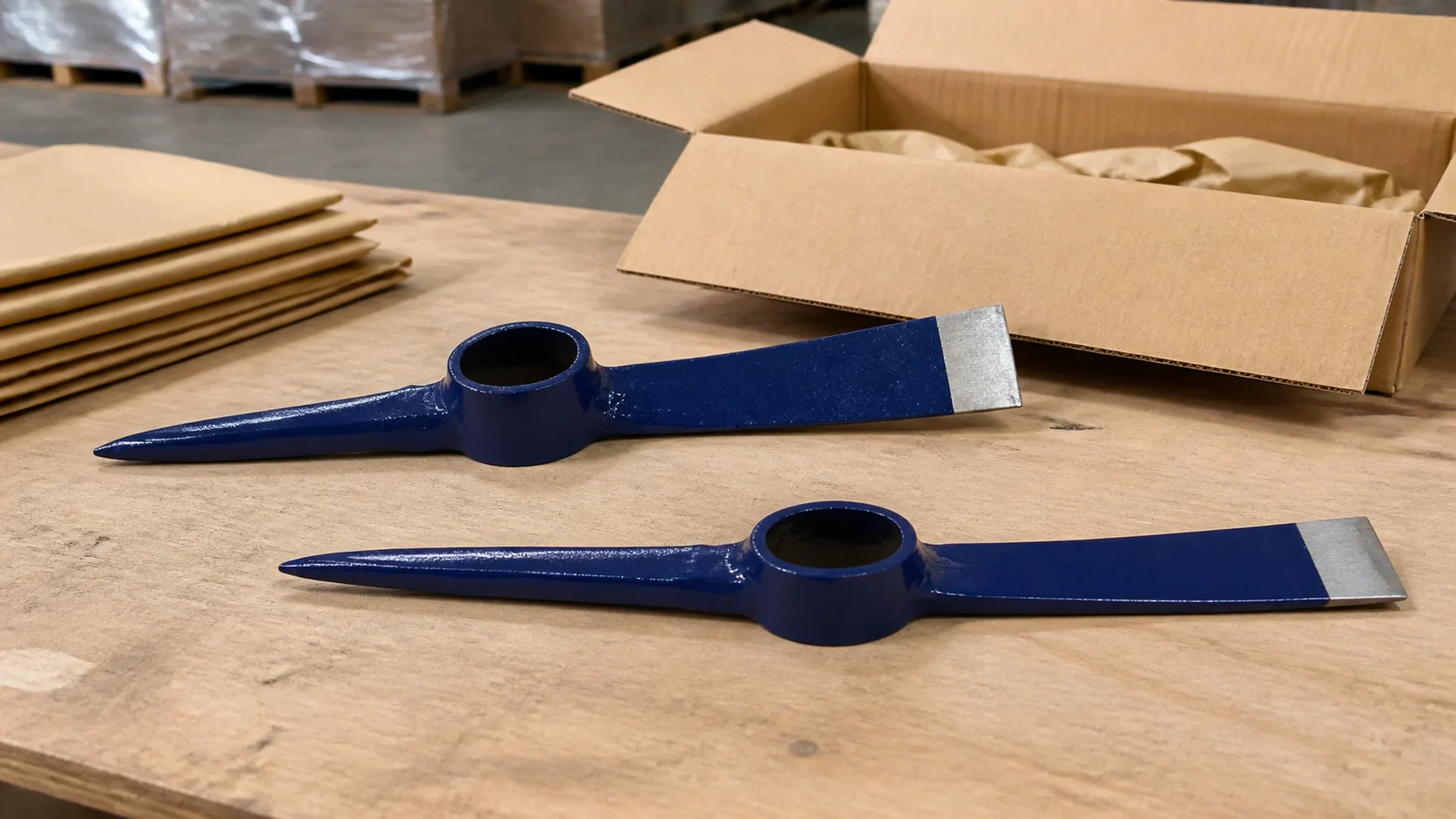
Product photos should be organized by SKU, not collected as a mixed group of similar tools. A P402 photo set needs to show P402, not a different pickaxe head, a finished handled tool, or a category image. That discipline is especially useful when multiple forged heads are being purchased together. It helps the buyer confirm the received goods against the approved version and reduces the chance of a visually similar but commercially incorrect model entering the shipment.
Build P402 into a wider hardware purchase plan
Steel Pickaxe P402 can be combined with compatible agricultural tools, garden tools, construction hardware, cutting consumables, and other items in a practical purchase program. The mixed-container hardware service supports buyers who need several product categories in one shipment without treating every SKU as the same packing problem. Each line remains separately specified while carton data, protection, and loading needs are reviewed together.
For a focused P402 quotation, send the selected weight option, associated head-size reference, oval-eye or handle requirement, required finish, packing format, quantity, destination market, and any other items planned for the order. China Tools Supply can organize the product comparison, sample discussion, packing review, QC photo list, and export planning around the actual buying list.